

Hull Efficiency
Computational Fluid Dynamics · Global Marine Hydrodynamics
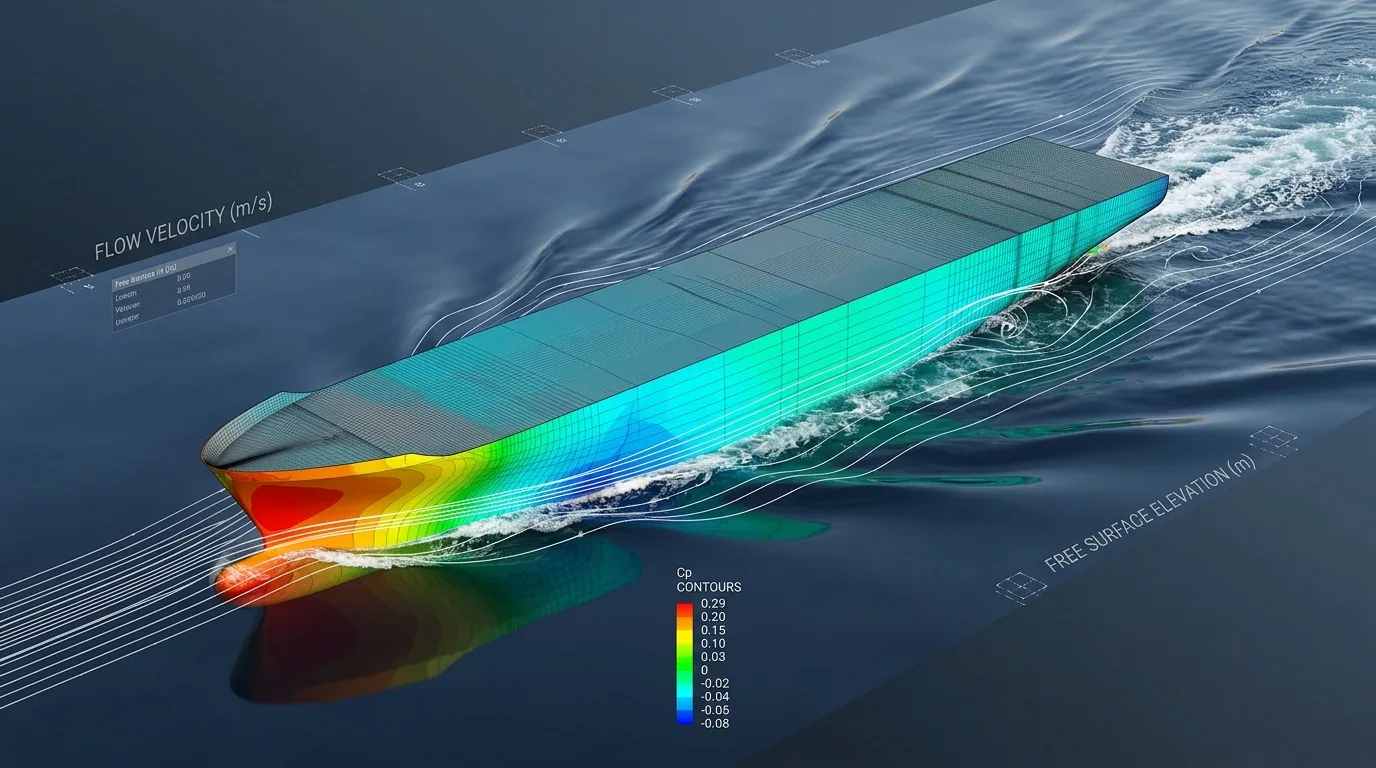
Ship CFD Simulation & Hydrodynamics
We answer your critical questions with CFD analysis:
- How much power will the vessel need?
- How will the hull behave in waves?
- What can we change before we build it?
Core Hydrodynamics
What We Deliver Today
Wave Added Resistance
Regular Waves & Head Sea Performance
Seakeeping Spectrum
Irregular Waves & Seakeeping Motions
Coupled 6-DOF
True 6-DOF Dynamic Running Attitude
Primary: cfMesh
cfMesh & snappyHexMesh Industrial Meshing
Volume of Fluid
Multi-Phase Free-Surface VoF Tracking
Force Balance
Hydrodynamic Lift vs. Weight Equilibrium
Propulsion Sizing
Effective Powering & Transport Efficiency
In-House Automation
Engineered with Trident CFD
Our marine hydrodynamics pipeline is powered by Trident CFD, our specialized in-house automation platform built on top of OpenFOAM Foundation v14. Trident CFD eliminates manual setup errors, enforces strict naval architecture quality gates, and orchestrates high-throughput parallel compute from CAD geometry to final powering predictions.
Compute Scalability
In-House HPC Turnaround Benchmarks
Our dedicated on-premise compute cluster eliminates cloud queue waiting times, delivering guaranteed, predictable engineering turnaround today with modular multi-node expansion for large-scale fleet campaigns:
In-House HPC Compute: 32 Physical Cores | 64 Parallel Threads | 192 GB RAM (AMD Zen 5 Architecture)
Swipe horizontally to view full benchmark details
| Analysis Tier | Mesh Resolution | Steady RANS | Transient VoF (6-DOF) | Engineering Scope & Suitability |
|---|---|---|---|---|
| Rapid Screening | 500k – 1M cells | < 30 min | 2 to 4 hrs | Hull form variation, parametric screening, preliminary resistance trends, initial dynamic trim & heave prediction. Rapid concept screening & early-stage naval architecture design iterations. |
| Production | 1M – 2.5M cells | 1 to 2 hrs | 5 to 10 hrs (Overnight) | High-fidelity calm-water resistance, wave pattern resolution, wake wash, transom separation, dynamic attitude balance. Contract verification, powering predictions, propeller inflow analysis. |
| Detailed CFD & Seakeeping | 2.5M – 5M+ cells | 3 to 5 hrs | 16 to 28 hrs | Fine boundary layer resolution (y+ ≈ 30–60), regular & irregular wave seakeeping, appendage drag, spray sheet tracking. Publication-grade V&V, wave added resistance, high-speed impact physics. |
Future Developments
Upcoming Technology Roadmap
01 Active Development
Automated Multi-Speed Sweeps
02 Standard V&V Procedure
Grid Convergence Index (GCI)
03 Upcoming Release
Propulsion & Appendage Interaction
04 Roadmap Milestone
Seakeeping & Head Seas (Overset Meshing)
05 Roadmap Milestone
Slamming & Impulsive Bottom Pressures
06 Future Capability
Fluid-Structure Interaction (FSI)
Naval Hydrodynamics & Performance Verification
Put your hull through its paces.
Looking to verify a new hull design, evaluate powering requirements, or optimize running trim before building? Send us your lines or a concept — we will run the numbers and tell you exactly where the vessel stands.